Our Research
Read Our Work
PRACTICAL INSIGHTS
Gray Dawn Briefings
Gray Dawn Briefings translates emerging developments in corporate governance, business and human rights, data governance, and national security into concise, executive-focused analysis. Each briefing explains not only what has changed, but why it matters for boards, executives, investors, and their advisors.
Designed for busy decision-makers, our briefings distill complex legal and policy developments into practical governance insights while providing links to deeper academic analysis where appropriate.
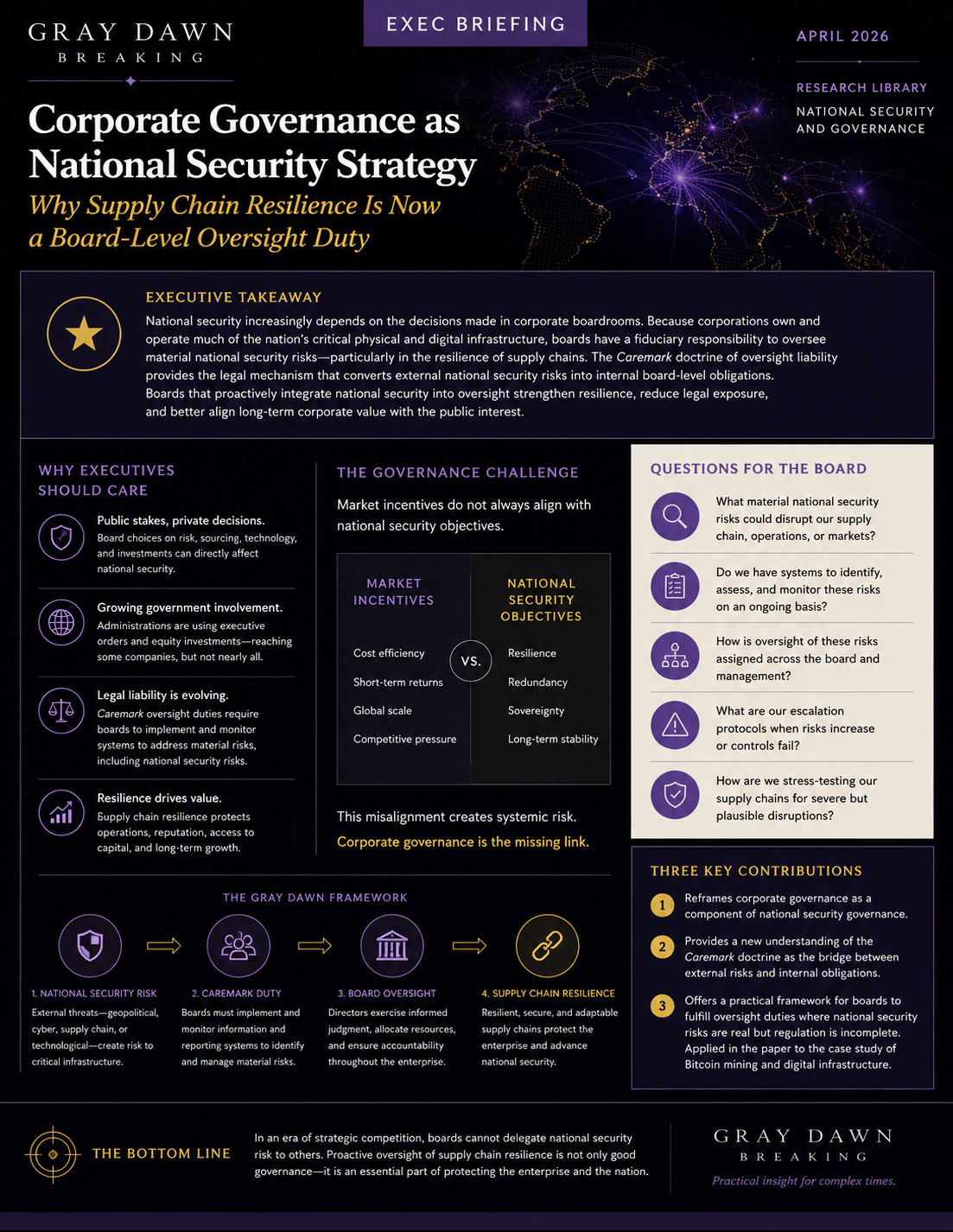
Briefing No. 2 | August 2026
The Hidden Supply Chain:
Why Every Company Needs a Data Supply Chain Strategy
This briefing introduces the concept of the data supply chain—the network of transactions through which organizations acquire, transfer, and transform data into the products and services they ultimately provide to customers. While companies routinely invest in managing physical supply chains, many overlook the data supply chains that increasingly underpin AI, connected devices, digital platforms, and other hybrid technologies. The briefing argues that disruptions to data supply chains can have consequences just as severe as disruptions to physical inputs, affecting business continuity, operational resilience, and even critical infrastructure.
The briefing provides a practical framework for boards and executives to identify and govern their data supply chains. It outlines the five primary methods by which companies acquire data—build it, buy it, scrape it, surveil it, and generate it—and offers a governance checklist for mapping suppliers, identifying dependencies, assessing risks, and strengthening oversight. By encouraging organizations to view data acquisition as an interconnected supply chain rather than a series of isolated transactions, the briefing equips leaders with a practical strategy for improving resilience, managing emerging risks, and building a stronger governance framework for the data-driven economy.
→ Download Gray Dawn Briefing
→ Read the LinkedIn Article
→ Download the Full Essay
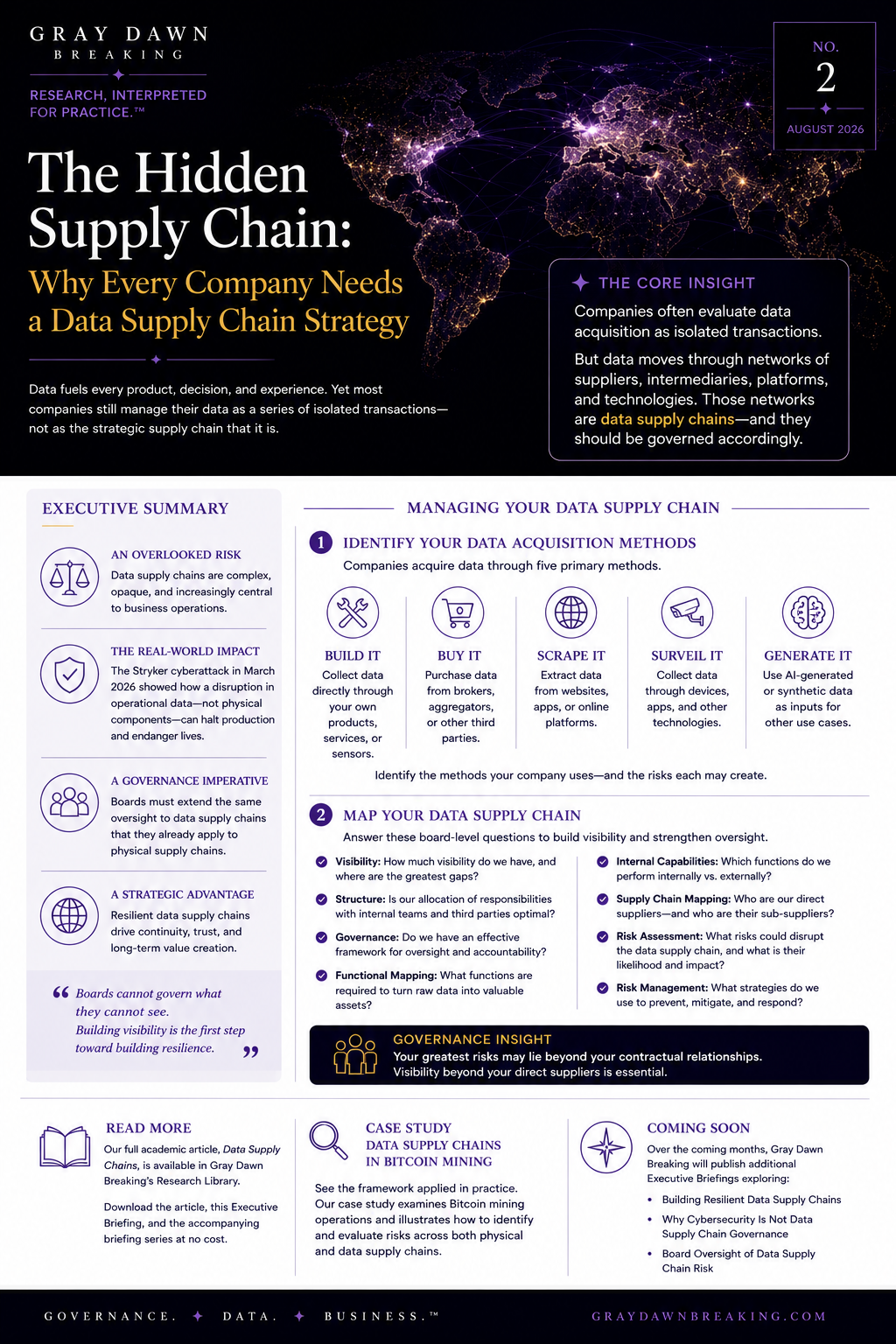
Briefing No. 1 | July 2026
Cisco's Consequences for Caremark
The Supreme Court's decision in Cisco Systems v. Doe I reshapes more than corporate human rights litigation. It may also weaken the governance incentives that encourage boards to oversee human rights risks under Caremark.
LATEST RESEARCH
Academic Scholarship
Gray Dawn Breaking's work is grounded in rigorous academic research published in leading law reviews and scholarly journals. We translate complex legal and governance scholarship into practical insights for directors, executives, policymakers, and corporate counsel. Explore our latest research alongside concise Executive Summaries designed to make cutting-edge scholarship accessible to decision-makers.
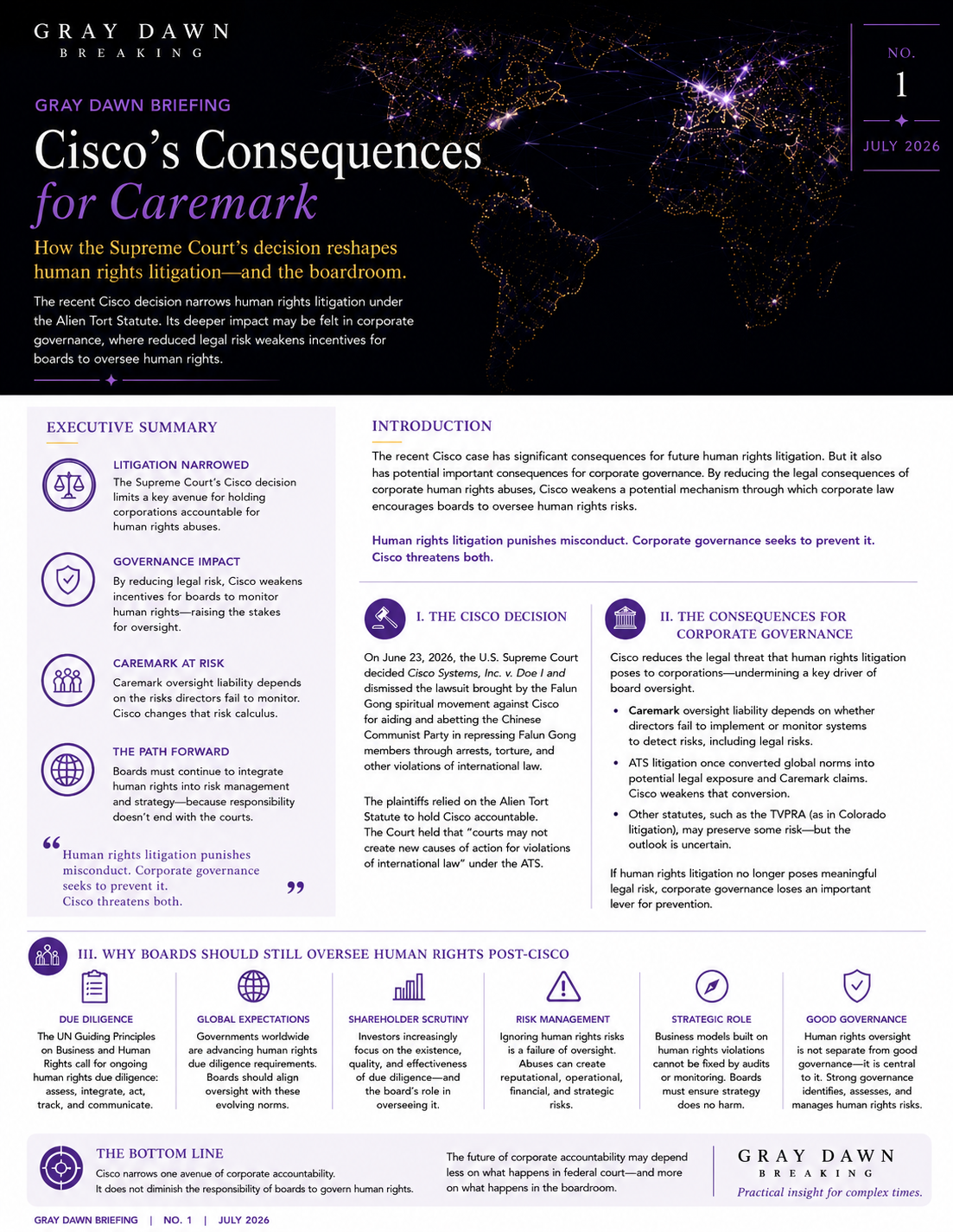
Corporate Governance & National Security
Corporate leaders increasingly operate at the intersection of business strategy and national security.
Decisions about supply chains, technology, cybersecurity, critical infrastructure, capital allocation, and enterprise risk management can have consequences that extend well beyond the corporation itself. As governments place greater emphasis on the resilience of privately owned infrastructure, boards should expect heightened expectations regarding their oversight of national security risks—even where regulation remains incomplete. This briefing examines how directors' fiduciary oversight responsibilities may provide an important governance framework for identifying, monitoring, and responding to emerging national security risks. It offers practical guidance for integrating these considerations into board governance, enabling companies to strengthen resilience, anticipate evolving expectations, and better align long-term corporate strategy with an increasingly complex geopolitical environment.
→ Download Executive Summary
→ Download Article
LATEST RESEARCH
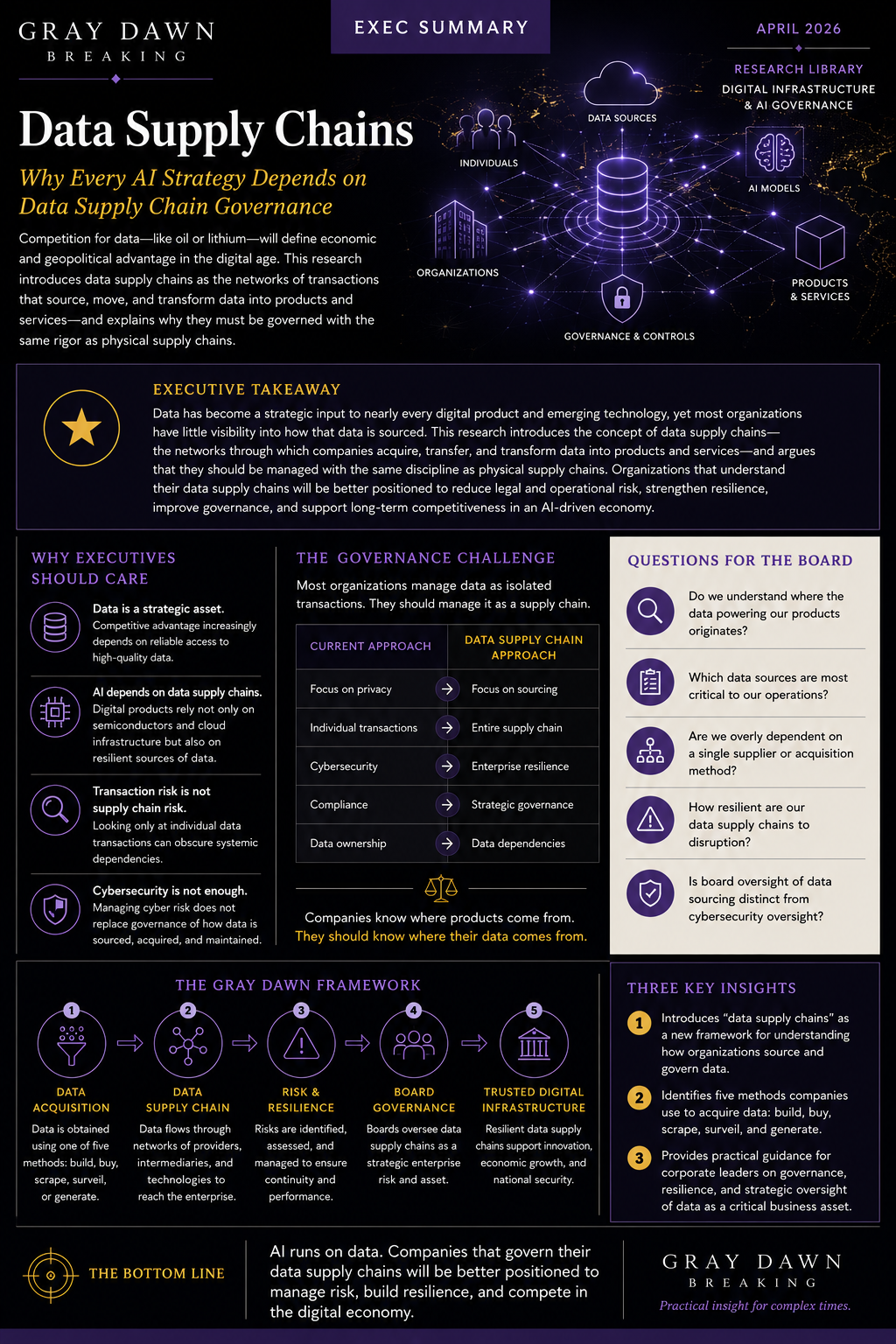
Data Supply Chains
Data has become a strategic asset that increasingly determines corporate competitiveness and national resilience.
Yet most organizations focus on downstream issues such as privacy and cybersecurity while overlooking a more fundamental question: where their data comes from. This research introduces the concept of data supply chains—the networks through which organizations acquire, transfer, and transform data into products and services—and identifies the five primary methods of data acquisition: build, buy, scrape, surveil, and generate. By treating data like any other critical supply chain, executives can better identify strategic dependencies, assess supplier risks, strengthen operational resilience, and govern data as a core business asset. For policymakers, the framework highlights the need to protect data supply chains as critical digital infrastructure while adapting supply chain governance tools to address emerging risks and harms associated with data sourcing.
→ Download Executive Summary
→ Download Article
LATEST RESEARCH
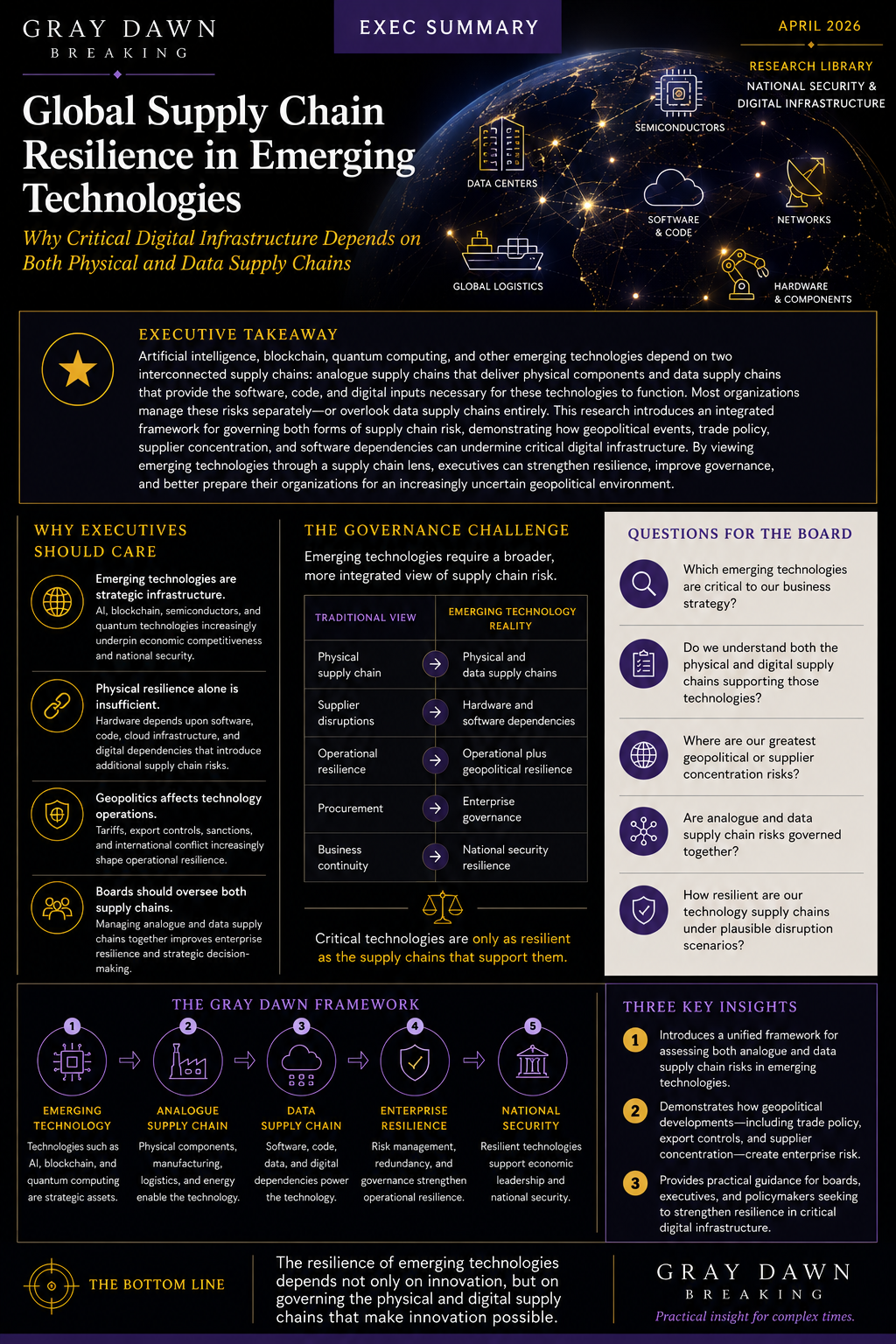
Global Supply Chain Resilience in Emerging Technologies
Emerging technologies such as artificial intelligence, blockchain, and quantum computing are becoming essential to economic competitiveness and national security, yet their resilience depends on supply chains that extend far beyond physical components.
This research demonstrates that organizations must govern both analogue supply chains (hardware, manufacturing, logistics) and data supply chains (software, code, data, and digital dependencies) to effectively manage operational and geopolitical risk. Using Bitcoin mining as a case study, the paper shows how disruptions arising from trade policy, geopolitics, supplier concentration, and software dependencies can affect critical digital infrastructure. It provides executives and policymakers with a practical framework for identifying supply chain vulnerabilities, strengthening resilience, and integrating supply chain governance into enterprise risk management as emerging technologies become increasingly central to national and economic security.
→ Download Executive Summary
→ Download Article
LATEST RESEARCH
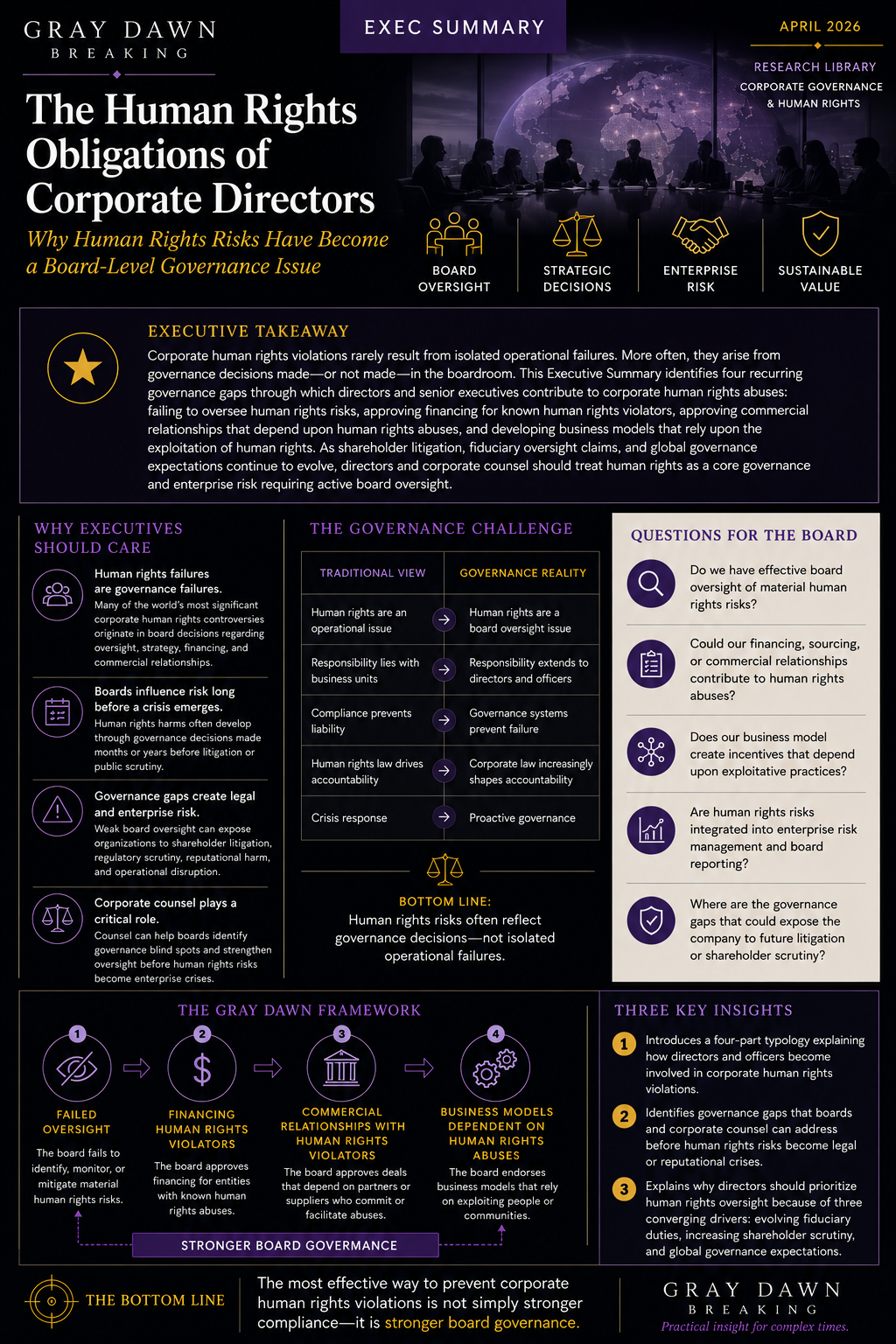
The Human Rights Obligations of Corporate Directors
Most corporate human rights violations begin long before a crisis becomes public.
They emerge from governance gaps in oversight, strategic decision-making, commercial relationships, and business model design. This paper identifies four recurring patterns of board involvement in corporate human rights abuses and explains how these governance failures create legal and enterprise risk. The framework helps directors and corporate counsel evaluate where governance systems may be vulnerable and provides practical guidance for strengthening oversight before human rights risks become litigation, regulatory enforcement, or reputational crises.
→ Download Executive Summary
→ Download Article
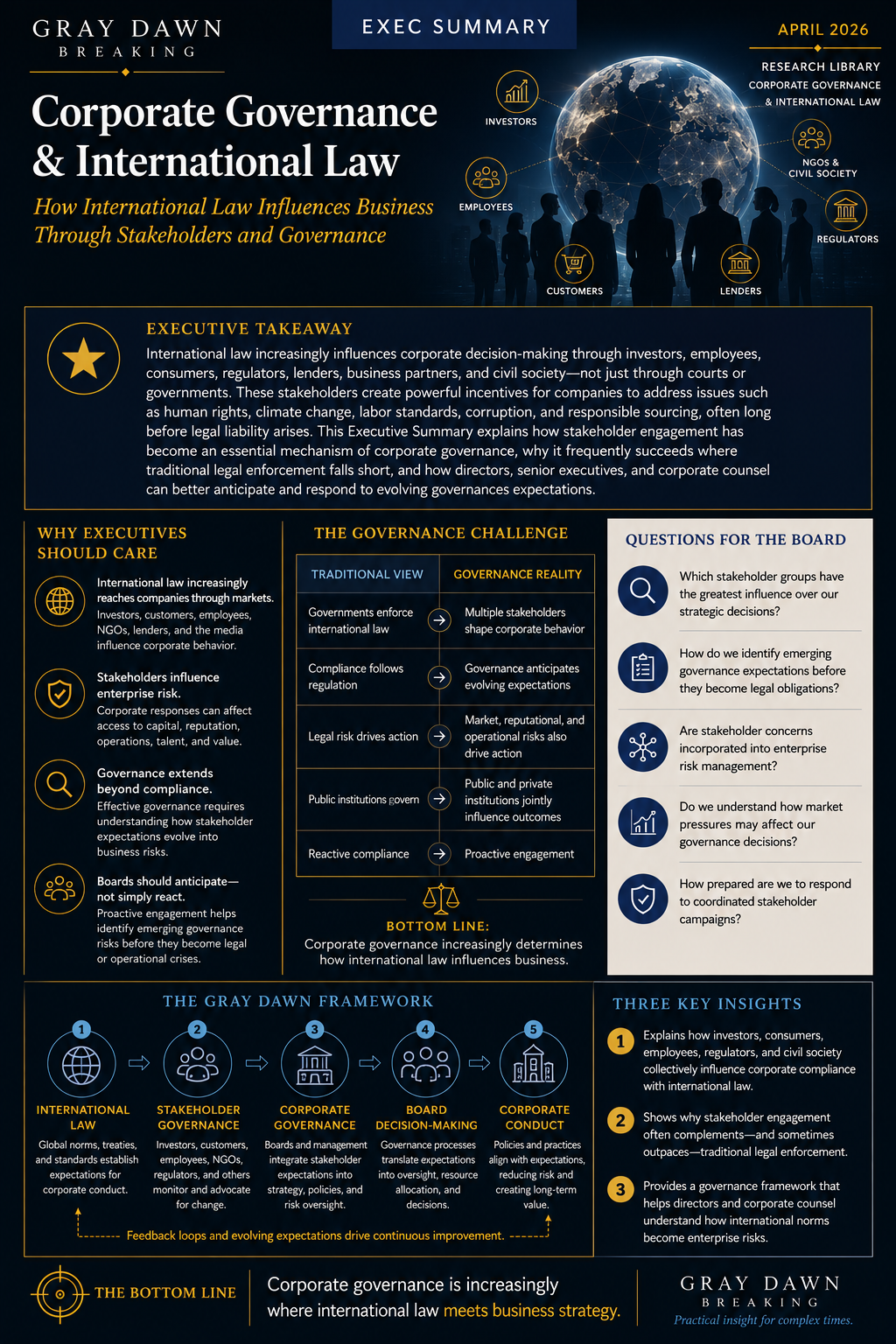
LATEST RESEARCH
Corporate Governance & International Law
Corporate governance is increasingly shaping outcomes once viewed as the exclusive domain of governments and international institutions.
As litigation, regulation, and stakeholder expectations evolve, directors and senior executives face growing pressure to address issues ranging from human rights and climate change to supply chain resilience and geopolitical risk. This paper explains how corporate governance serves as a bridge between international law and business by translating global norms into corporate decision-making. It demonstrates how investors, consumers, employees, regulators, and other stakeholders collectively influence board decisions and why understanding these governance dynamics is essential for directors, corporate counsel, and executives navigating an increasingly interconnected global business environment.
→ Download Executive Summary
→ Download Article